"The team got faster, so we can run it with fewer people." I've heard some version of that sentence in a lot of rooms this year. Honestly, I've even said it myself many times in my career. Recently however, the tone with which it's been delivered has had a familiar ring to it. The slightly weary tone of a leader naming a hard truth. AI is making the work quicker, the logic goes, so headcount is the savings we get to bank. It's how we pay for the cost of all these tokens we're consuming and it gets framed as a tough (or maybe welcomed) tradeoff. Productivity on one side, people on the other, and a responsible leader makes the cut.
Most of the time, nobody tested whether that was a tradeoff at all. They assumed it.
Here's why the assumption slips through. A tradeoff is a weighing of two things, and in these rooms only one of them ever gets weighed. The productivity gain is immediate, countable, and ready for the board deck (assuming you're implementing the right solutions in the right way, of course). The cost of cutting is deferred and invisible: the capacity you'll need when demand comes back, the knowledge that walks out the door, the rework that surfaces two quarters later, the trust you spend. Too many leaders are failing to weigh a number against a number. They're weighing a number against a feeling, and the number wins by default. That's not a tradeoff. That's a measurement failure wearing a tradeoff's clothes.
I'll be upfront about my bias. I don't think layoffs are usually the answer, and not for sentimental reasons. Most layoffs are a shortsighted response to a longer-term problem: you cut people to fix this quarter, and the real problem, whether it's demand, strategy, or capability, is still sitting there next quarter, now with less talent in the building to solve it. Protecting people's livelihoods and protecting the enterprise are the same discipline far more often than the spreadsheet admits. AI has simply handed leaders the newest and cleanest-looking reason to make that trade.
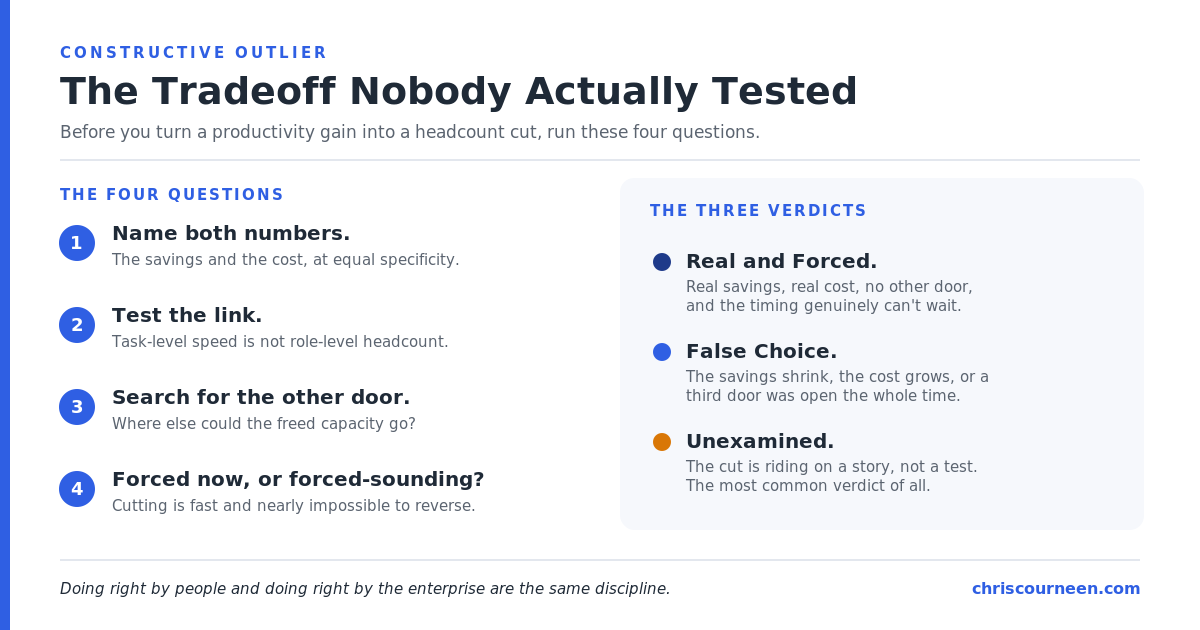
So here is the framework I use before I'll accept that a productivity gain forces a headcount cut, a pause in hiring, or a redeployment of capacity to a new team. Four questions. Any leader making this call owes their organization all four before rendering the verdict.
Name both numbers. Not just the savings. Both sides, with equal specificity. Which line moves, by how much, over what period, and set against it, what specifically breaks: whose capacity disappears, what quality slips, what risk moves downstream to someone who used to have a specialist catch it. If you can produce the savings figure to the decimal and can only offer "some morale risk" on the other side, you don't have a tradeoff. You have half a spreadsheet.
Test the link. This is where the AI version quietly falls apart. Productivity shows up at the task level. Layoffs happen at the role level. A tool that makes one task thirty percent faster has not made thirty percent of a job disappear, and you cannot subtract a task from a headcount line. Five people who are each twenty percent faster is not one person you can let go, unless that freed time is concentrated in one place, transferable, and sitting on the critical path. Usually it is none of the three. The studies leaders quote in these decisions are almost always task-level. A controlled trial had developers finish a specific coding task about 56 percent faster with GitHub Copilot, and a study of more than 5,000 customer support agents found roughly a 14 percent lift in issues resolved per hour, concentrated almost entirely among the newest workers. Real gains, both measured at the level of a task, not a job. And the task number doesn't always survive contact with real work: when researchers at METR tested experienced developers on codebases they already knew in 2025, AI tools made them about 19 percent slower, even as those same developers believed they had been sped up by 20 percent. And there is a second catch: when a task gets cheaper, organizations tend to do more of it, not the same amount with fewer people. The freed hours get eaten by the backlog you were already behind on, and realized headcount savings land at zero. Economists call this the Jevons paradox: make something cheaper to use and total use tends to rise, not fall. The classic labor example is the ATM. When cash machines spread in the 1980s and 1990s, everyone assumed tellers were finished, yet teller employment actually grew, because ATMs made branches cheaper to run, banks opened far more of them, and the teller job refilled with the relationship and problem-solving work the machine couldn't do. The demand didn't vanish. It moved. This may or may not be good, you have to decide that, but you also must name this explicitly and be transparent on where that newly discovered task-time is being spent.
Search for the other door. Almost nobody does this step, which is exactly why you should. Before you accept "cut or keep" as the only fork, someone has to be able to describe where else the freed capacity could go, and why that was rejected. If no one in the room can describe that conversation, it didn't happen. And in most organizations the other door is standing wide open, which I'll come back to, because it's the part that surprised me most in my recent discussions.
Ask whether it's forced now, or just forced-sounding. Cutting is fast and nearly impossible to reverse. Rehiring is slow and expensive. The blow to culture and trust is significant and the recovery time is slow. Holding capacity through an uncertain transition has real option value, and AI adoption is deeply uncertain right now. A lot of these cuts are being made off a six-week pilot that hasn't proven it holds at scale. "Forced forever" and "inconvenient this quarter" are different decisions, and they read very differently once you're honest about which one you're actually in.
Run those four and you land in one of three places.
Real and Forced. The savings are real, the cost is real, the other door was searched and closed, and the timing genuinely can't wait. This happens. Sometimes demand has actually collapsed and AI is just the accelerant on a cut that was coming regardless. Pretending every hard call has a free lunch hiding in it is its own kind of dishonesty.
False Choice. The savings shrink under scrutiny, the cost grows, or a third door was open the whole time. More common than any room wants to admit.
Unexamined. Nobody can produce the numbers or the search with any specificity. The cut is riding on a story, not a test. This is the most common verdict of all, and for AI-justified layoffs specifically, it is very nearly the default. We are starting to get the receipts. In an Orgvue survey of more than 1,000 senior leaders, 39 percent said they had made people redundant because of AI, and of those, 55 percent later admitted the decision was wrong. Klarna is the headline case: it cut roughly 700 customer service roles in favor of an AI assistant, then started rehiring in 2025 after quality slipped, with its CEO conceding the company had leaned too far toward cost and efficiency. Forrester now expects about half of all AI-attributed layoffs to be reversed in some form. That is what an unexamined verdict looks like at scale: the savings get booked, the cost shows up later, and the reversal runs more expensive than the discipline would have.
Here's the part too many people miss, and why this framework may help. The AI-justified headcount reduction/redeployment/layoff can destroy the very productivity it claims to harvest. Adoption depends on trust. The moment being good with the tool is what gets your colleague cut, everyone quietly slow-walks the tool. This is the fundamental reason employees fight (or find unnecessary flaws) in these tools. What if the fear is your own job and not your colleague? Usage goes underground, people stop volunteering what they've automated, and the gains you were counting on to justify the cut never fully show up, because the organization just learned that surfacing them is dangerous. You can cut your way out of the productivity you were trying to bank.
Now that open door. When leaders wave off redeployment, the reflex is "if that work were worth doing, we'd already be doing it." That objection is the same measurement failure as the layoff, committed a second time. The back-burnered work isn't low-value. It's low-legibility. I suspect in many cases, its value was never measured either, so it lost every prioritization assessment to work that was easier to count. I've seen, even in my own work, that things have been undervalued because they were crowded out, not because they were worth less.
Freed capacity flows naturally toward exactly that work, because AI takes the executable layer first. What's left is the high-judgment, high-relationship, high-context work that was always hardest to measure. In most functions that pile is deep, and in the world of HR work, it's deep, muddy, and hard.
Even in this deep, muddy HR world of "high value work", task-time given back is decision-time regained: more deliberation on the high-stakes, high-error-cost calls that currently get rushed. More consistency across managers instead of idiosyncratic judgment. It's the relational work that compounds, the skip-levels and floor time that get you to the ground-reality of culture, coaching managers instead of just processing their requests or solving their problems, building the influence that gets good ideas adopted. It's the shift from firefighting to prevention, catching the flight risk before the resignation and the conflict before the escalation. It's the added touch in candidate, employee, and customer experience that is always the first casualty of a full calendar.
And the one I'd put above the rest: time back in the business. HR spending real hours inside the operation, learning how the company actually makes money, is the thing the function says it wants most and funds least. It's the multiplier on every other item on that list, because HR that knows the business makes better calls, builds influence faster, and designs things that fit reality. Give that back and you haven't saved a salary. You've upgraded the function.
Let me be precise about what I'm not saying. This isn't that people always win and profit always loses, or that every hard call is secretly avoidable if you just care enough. It's exactly the opposite. Doing right by the business and doing right by people were never opposing forces. They are both conditions of the same goal. And this isn't skepticism about the technology. The productivity is real. The tools are doing the work. The lazy part was never the AI. It's the arithmetic leaders reach for next.
That is the real point. Freed capacity is not a savings that banks itself. It's a decision about where the capacity goes, and that decision only pays off if a leader actually makes it. Let the hours dissolve into slack and the skeptic is right, the value evaporates. Point them at the work that was always too important to get to, and you've moved the enterprise forward. That's orchestration, the same leadership call I wrote about last time. A layoff made to bank a productivity gain without discipline is the anti-orchestration move: instead of directing the capacity you just unlocked, you delete it, and then you call the deletion discipline.
The tell is simple. A tradeoff you've actually tested, you can defend with two numbers and a door you checked. A tradeoff you've only assumed, you defend with a tone of voice.
Which cut on your roadmap right now is wearing a "we can do more with less" label it hasn't actually earned?